Posted by: Matt Browner Hamlin | April 22, 2009

El Batey

elbatey_mario

Mario of El Batey

While I was in Puerto Rico last week, I was fortunate enough to come across a great dive bar in Old San Juan: El Batey. This discovery pretty much was what assured I had a great time in San Juan. After all, while I love fine cocktails, at heart I’m an East Village dive bar guy. I’ve always loved going someplace where the beers are cheap, the shots are strong, and there’s a great juke box and pool table to keep you entertained. El Batey had all of these things in spades.

We found El Batey on our first night in Old San Juan. On our way to dinner at a somewhat upscale restaurant, we’d passed a rum and cigar bar. It looked swank and like it was the sort of place where we could sit with some other tourists and enjoy a number of overpriced sipping rums. After dinner we went back to that bar, whose name escapes me. Looking in, it seemed bland and uninteresting. We looked across the street and saw what could only be described as an obvious dive.

El Batey is immediately distinguished by its walls. Almost every inch of the walls, from floor to ceiling, were covered in graffiti, tags, and impromptu art. Its well-worn bar looked inviting, so we said screw to the fancy rum bar and pulled up to the stick in El Batey, where we were promptly greeted by one of the friendliest and most outgoing bartenders I’ve ever met, a guy named Mario.
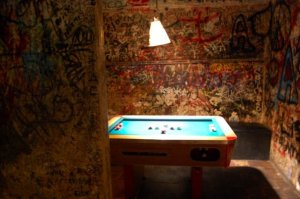
elbateyMario quickly explained to us the history of El Batey. It was bought in the mid sixties by the current owner, a man named Davey Jones. We questioned whether this was really his names, but Mario assured us it was and that he was still around busting heads to keep the place in order. When Davey bought the bar, he worked hard to keep the walls clean, frequently repainting any graffiti added by sailors and other passers by. By the late sixties, he gave up on that Sisyphean effort and let come what may. The result was a bar with more Sharpie ink than whitewash visible to the eye. It gave the bar an intimate, lived-in feeling. You knew it was a spot that plenty of other people had chilled in for many, many nights in the San Juan heat.

The drink of choice at El Batey through our three visits was Medalla Light, Puerto Rico’s main local beer. Even though it’s a light beer, it’s actually a nice lager on par with the likes of Red Stripe or Bo. It was actually pretty phenomenal and it’s a shame that it isn’t exported, as I could easily see it remaining my go-to cheap beer if it was available for me here in DC. At $2.75 per can, the price was right. Beyond Medalla, most other patrons at El Batey were drinking (primarily DonQ) rum highballs and shots. The bar was simple, like all good dive bars, and there certainly wasn’t a blender whipping up pina coladas taking up space in the bar.

View from below

Another cool feature of El Batey was the two large lamps that hung over the bar. Taped around the lamps were strings of business cards left by past visitors to El Batey. When the strings get too long, the take them down, leave the newest one, and start again. There’s no raffle or free crap associated with leaving cards behind – just a cool piece of public, organic art that gives the bar even more character.

The music selection was great. The mix was primarily blues, soul, and classic rock and roll, though later in the nights bartenders’ iPods would occasionally mix in reggaeton and ska. The music fit the bar well and like the rest of the scene, made me feel like I was hanging out in an East Village dive bar relocated to the Caribbean. Beyond the juke box, the bar also had a pool table and a bumper pool table.

The crowd at El Batey was a mix between locals, US ex pats, and tourists. Not too many other tourists came in and stayed for the long haul. The regulars were friendly (though a guy dressed up like a pirate and carrying a parrot was a little too friendly – but hey, bar with a pirate!).

El Batey was my kind of bar, top to bottom. I’m looking forward to visiting it again down the line if I’m back in Old San Juan. If you’re in Puerto Rico, I definitely recommend stopping by and asking for a Medalla from Mario.

Posted by: Matt Browner Hamlin | April 21, 2009

The Gibson, Now With More Gibson Free

I’ve been meaning to blog about this for a while, but have been somewhat lazy, out of town, lazy, etc, but Wonkette reports that The Gibson will be opening their back patio soon. As any visitor to The Gibson may have noticed, the back patio already has a bar built there. It’s been sitting empty, as has most of the patio, through the bar’s wintery existence.The only booze to be found there so far were kegs waiting to be tapped by the crowd at Marvin’s.

While the patio will be a similar set-up as inside the bar — great drinks, not over-crowded, and so on — there will be a few differences. First, there won’t be reservations but seating will be done on a first-come, first-serve basis. This also means there won’t be a time limit to visits for people who arrive early. The back patio will also have a slightly different menu, with a greater emphasis on punches and tiki drinks than the interior bar. I’ll be curious to see how that gets played out.

I’m not sure what the current thinking for when the back patio will be opened. Last month I remember hearing early/mid-May, but I don’t know if that’s operable now. In any event, expect more great things from the bar staff at The Gibson with the expanded space.

Update:

Via Jeff Fulcher in the comments and at his Cocktail Revolution, I see the patio at The Gibson is currently open. Fritz Hahn of the Washington Post has a review of it and the menu changes. I haven’t experienced the new menu yet, so I’ll withold judgment, but it looks like one of the cocktails is an original by Tiffany Short whose creative process I had a bit of input into (naming ideas, rough draft tasting, and suggestions for spirit ratios). Fritz describes it:

The Meridian, which includes gin, both sweet and dry vermouths, crème de violette, rose water and orange bitters, is too floral — the rose and violet flavors seem to be stepping on each other.

I’ll have to try the final, menu version, but I think Tiffany was really onto something with this drink – a light, floral take on a martini. I’ll be curious to see how it all turned out, as it is one of the first times I can recall sampling something prior to its arrival on a menu at The Gibson.

Posted by: Matt Browner Hamlin | April 17, 2009

More on Mayahuel

Lindsey Johnson of Lush Life made a trip to Mayahuel pre-launch and has a write-up along with menu photos. Phil Ward’s cocktails look amazing and I’m getting a serious hankering for some agave.

Posted by: Matt Browner Hamlin | April 16, 2009

The Bacardi Distillery

Bacardis Mojito & Daquiri

Bacardi's Mojito & Daiquiri Facsimiles

On my second day in San Juan, we visited the Bacardi Distillery. Now I can’t say I’m the biggest fan of the Bacardi brand, but how could I miss the biggest rum distillery in the world? Getting to the distillery involved a short ferry ride across the bay and the Bacardi campus was big, green, and clean. Best of all, the tour was free and came with two free drink samples.

When we arrived, we were told we had 45 minutes before the next tour. After a quick look through the surprisingly sparse gift store, we moved on to the outdoor bar, set in a really ugly, 1960s era outdoor pavilion.

My friend Austin ordered a Mojitio and I ordered a Daiquiri. What we got was quite remarkable: probably the worst mojito and the worst daiquiri in the world. While at the world’s most famous rum distillery.  My daiquiri was made of a highly watered down sweet and sour mix and the rum. It hit all the wrong notes in what you’d want with a good daiquiri – sweet, watery, and only chemical notes of sour, along with almost no rum taste. The mojito was even worse and we should have seen it coming, as it was served out of a large container with no visible signs of spearmint leaves.

It wasn’t until we went back in the gift shop to see if the prices on rum bottles might be low enough to assuage our dissatisfaction with the cocktails we’d been served that I realized the reason for the crappiness of the mojito. Bacardi makes a bottled mojito mix for sale to the public. It’s really nothing more than a rejiggered sweet and sour mix where all you have to do is add rum and ice. Naturally since Bacardi makes this godforsaken mix, they’re obliged to push it in their cocktails at their distillery. Sadly, this course of action confirmed for me how awful a mix I would never dare buy was, as well as being a strong clue in to the coming mediocrity of the distillery tour.

I’ve been on a few distillery, brewery, and vineyard tours. I go on them because they can be incredibly interesting and informative. For whatever reason, the Bacardi distillery guided tour missed the mark in a big way. It was hokey, superficial, and too long for a guided tour. It just didn’t do anything for me and as a result I’m going to be advising friends who visit Puerto Rico to take a pass on the Bacardi distillery (unless they don’t actually like mojitos and daiquiris).

Posted by: Matt Browner Hamlin | April 15, 2009

Can’t Wait

Photo by Ian Ference of UrbanDaddy.com

Photo by Ian Ference of UrbanDaddy.com

Phil Ward and the crew from Death & Company are at it again, with a new tequila-focused cocktail bar in the East Village called Mayahuel. It’s not open yet, but UrbanDaddy has a review (public opening is May 1st).  It sounds awesome and I’ll try to stop by the next time I’m in New York City.

Posted by: Matt Browner Hamlin | April 15, 2009

The Pina Colada

I just got back from my vacation to Puerto Rico. One of the interesting things about visiting there was the number of uniquely Puerto Rican drinks – or at least drinks that Puerto Rico’s rum culture cling closely to. From the Mojito to the Daiquiri to the Cuba Libre, Puerto Rico has found some ways to put rum in your belly. The one that is most quintessentially Puerot Rico, though, is probably the Pina Colada [Edit: Though I think PR’s native beer, Medalla Light, probably is a bigger draw].

The origin of the Pina Colada is under dispute. But to the extent that something being written in stone matters, the Restaurant Barrachina has this plaque nailed outside their entrance, claiming rights to the creation of the drink in 1963:

I was able to sample “original” Pina Colada while at Restaurant Barrachina. The frozen drink was premixed and waiting in dispensers at the bar. The only addition was rum. In our case, we went with Bacardi Select, which added a nice brown ripple through the cocktail.

I’ve said before that I’m not a big fan of Tiki drinks. To understand the extent to which sweet, frozen drinks aren’t my think, I could safely say that frozen drinks like a Pina Colada make me long for the heady, booziness of a Tiki drink. That said, it was in the mid 90s throughout my stay in Puerto Rico. And in the middle of the day, drinking my first Pina Colada at Restaurant Barrachina, I felt refreshed drinking the sweet, sweet flavors of a Puerto Rican original.

I didn’t have another Pina Colada after the one at Barrachina throughout my trip. I’d thought about going to the Caribe Hilton in Old San Juan, who also claims to have created the Pina Colada…in 1954. But at the end of the day, the kitsch of drinking a drink that I’m not terribly enthused by at a bar connected to its creation didn’t sound that compelling.

It’s also worth noting that my visit to Restaurant Barrachina was just one small part of a trip that seemed to recreate the Three Sheets episode in Puerto Rico. In it, Zane Lamprey visited Barrachina for the pina colada. He also made mojitos at NoNo’s, an Old San Juan bar that happened to be one of my first stops on Day One. Naturally, in addition to a couple Medalla’s, we sampled their mojito. Good stuff, but nothing mindblowing. And unfortunately it turned out to be one of the best mojitos we had on the trip.

I’ll have a couple more posts in coming days about my trip to Puerto Rico and the rum, beer, and cocktail experiences I had while there.

Posted by: Matt Browner Hamlin | April 9, 2009

Puerto Rico

I’m on vacation in Puerto Rico for the next five days and probably won’t be posting much due to a lack of good internet connection and a desire to, you know, be on vacation.

I will hopefully be drinking some great rums and rum cocktails and plan to stop by at least one major rum distillery. I’ll have posts on these at some point, though not necessarily as it happens.

Regularly scheduled program should resume by next Wednesday…

Posted by: Matt Browner Hamlin | April 7, 2009

P0wnage

I agree with Doug, Jeffrey Morgenthaler’s take-down of the American Bartending School’s “daquiri” video lesson is as brutal a gut shot as I’ve seen thrown on cocktail blogs.

That said, during the Great Astroturf Pushback of Aught Nine, Le Tourment Vert and Cashmere Agency were hit pretty danged hard too. Gabe’s post at Cocktailnerd and Blair at Trader Tiki were vicious and most others had some strong hits on Cashmere and LTV, too.

Posted by: Matt Browner Hamlin | April 4, 2009

Review: Michael Collins Single Malt

Irish has long been my favorite type of whiskey. Jameson opened my eyes to it and over time, I’ve gone from being a basic consumer of blended Irish whiskeys to more recently beginning to venture into the single malt realm. Red Breast is my favorite Irish single malt but I’m always happy to explore the genre and see what else is out there.

I hadn’t known that Michael Collins made a single malt Irish whiskey. It’s distilled by Cooley, the last independent Irish whiskey distillery. I was familiar with their blend and while it isn’t one of my favorites, I’ll order it sometimes if I’m at a bar that only has the standard Jameson and Bushmills blended varieties. Apparently the single malt recently won a Double Gold Medal in the Single Malt Irish Whiskey category at the 2009 San Francisco World Spirits Competition.

The nose from Michael Collins Single Malt is a strong mix of oak, peat, and leather. The strength of the oak nose isn’t surprising, given the whiskey is aged in oak barrels.  It doesn’t give the sweet bouquet that I’m used to with many Irish whiskeys. The peat really comes out when the whiskey hits the front of the tongue, though it doesn’t dominate after the first sip. Also present is a nice pepper spice, vanilla, and toffee. The Single Malt is very smooth with a light mouthfeel that isn’t oily or thick. There’s only the slightest lingering burn on the tongue.

What’s interesting to me is that Michael Collins Single Malt has a really complex taste while maintaining the smoothness I expect from a blended Irish whiskey. Each sip revealed slightly different proportions of peat, vanilla, oak, and pepper to me.

After writing this, I went back to the release announcing the Double Gold for the Single Malt and saw that this whiskey’s tasting was described as:

Aged for a minimum of eight to over twelve years, it has aromas of chocolate malt with light citrus and honeysuckle notes.  Well-rounded and complex with rich maltiness, it finishes long with a hint of chocolate and a wonderfully settled smoke that lingers on the palate.

I’m the first to admit that my palate isn’t the most advanced or tuned in to the various flavors and scents found in a spirit. But I really didn’t get either the chocolate malt or the citrus notes in the nose. I did, however, really enjoy how light the peaty-smoke flavor is that stays in the aftertaste. I’m not a fan of very peaty Irish whiskeys and I think the Michael Collins Single Malt reaches a level of peatiness that I find appealing for the depth and complexity it gives the spirit, while keeping it accessible to my tastes.

I’m not sure that the Michael Collins Single Malt is going to supplant Red Breast for my favorite Irish single malt, at least not in one tasting. But I’m looking forward to spending more time with this whiskey and definitely think it’s worth a try for someone who’s looking to move from blended Irish whiskeys onto single malts.

Posted by: Matt Browner Hamlin | April 3, 2009

A Shot Across the Bow at Cocktail Blogs?

Don’t look now, fellow cocktail bloggers, but I think my pal Derek Brown is firing a shot across our bow! In his latest blog post for The Atlantic, Derek critiques “cocktail snobs” and the impact they have on bartenders. Now, in fairness, it’s the title of the post, “What Makes a Cocktail Snob so Obnoxious?” that really sets off alarm bells, with a very reasonable article beneath it. The post opens:

I have to admit, albeit begrudgingly, that it is sometimes those with the most distinctive tastes–and sometimes the most abrasive attitudes–that make us better bartenders. I’m talking about snobs. It’s their insistence on attention to the finest details, their unrealistic notion of what is possible behind the bar, and their singular expression of taste that assure we will work twice as hard, twisting over backwards in some slinky-like stair crawl to meet their expectations. That is, if we make the effort and don’t dismiss them out of hand.

Derek goes on to use David Embury’s controversial 1948 book, The Fine Art of Mixing Drinks, and Embury’s consistently problematic take on cocktail recipes as an example. Looking at Embury’s awful rendition of a Sidecar, Derek explores the Sidecar himself:

Yet because of this one line and the subsequent recipe, I have made a heroic effort to study the proportions and best his recipe. It pushed me to explore various recipes and evaluate each one separately. If one takes it in the right spirit, snobs become connoisseurs and their solipsism appears to stem from the dictum: know thyself.

I think this shows that Derek is a committed bartender, willing to work to make a recipe great. But the impetus came from a non-bartendering author and he’s able to give credit to him here.

What troubles me is that while I know a lot of cocktail bloggers aren’t bartenders (I fall in that category), most of my brethren write about cocktails because of the joy we take in them, not out of a desire to snobbishly tell the world what is right or wrong. Sure, I’ve seen some under informed guests of fine bars who think one visit to Death & Company makes them world-class cocktail critics. Those are the people that seem the most susceptible to obnoxiousness. But I think most cocktail bloggers and true fans of craft cocktails come to the bar with genuinely good intentions. It’s very rare for me to find an on-menu drink that I really dislike. And at the bars I visit the most here in DC – like The Gibson or Bar Pilar – the mixologists know my tastes well enough to serve up drinks that I almost always like. In fact, it’s quite common where I’m happy to defer to my bartender for what I’m drinking.

I think most craft cocktail bartenders that I know really work towards the clientele that knows their cocktails. At the end of the day, they have to. Without people interested in great cocktails, great cocktail bars wouldn’t exist. The steady stream of smart customers is what gives bartenders an outlet for new recipes…recipes that often need some level of critique to be improved.

All that said, professional bartenders have spent centuries perfecting recipes. We all relate to them differently and there’s nothing wrong with having different tastes. But criticism of cocktails shouldn’t lead to recipe authoritarianism, at least not at the hands of non-bartenders.

Or if that doesn’t work for my fellow cocktail bloggers, we could just start organizing against Derek Brown and demanding David Embury recipe Sidecar’s at The Gibson until he gives in and retracts this post…

Posted by: Matt Browner Hamlin | April 2, 2009

Owen Thomson’s Handcrafted Bottled Cocktails

Last night at Bourbon in Adams Morgan, Owen Thompson hosted a bottled cocktail night. Essentially a plan that seemed to allow him to work a night while doing as little as possible at the bar, we got to benefit from some incredibly tasty prepared drinks. The concept is simple: bottled cocktails are cocktails that can be prepared in large batches prior to an event. They can be kept cool in a refrigerator or cooled at serving time either in a large punch bowl with ice or shaken/stirred individually for serving. Obviously bottled cocktails only work with cocktails that don’t have drinks with huge consistency issues or ingredients like cream, eggs, or carbonation. Traditionally drinks that only consist of spirits are common for bottled cocktails, but if the time line for serving is short, fruit juice is possible too.

Owen’s menu last night included four drinks: Blood and Sand, Martinez, Jack Rose, & Hemingway Daquiri. Between me and my friends, we tried all of the drinks. Naturally my favorites were the ones that I ordered: a Martinez and a Hemingway Daquiri, which are two of my favorite cocktails of late.

The drinks were served in plastic 200 mL flasks along with a pretty swanky label, viewable to the right. I thought about saving one for later use, but Owen apparently takes a page from Major League Baseball and wasn’t serving the bottles with caps attached. Oh well.

The bottled cocktails were a great excuse to get out on a rainy Wednesday night and another sign of how DC’s craft bartenders are finding innovative ways to bring folks together around great drinks.

Posted by: Matt Browner Hamlin | March 31, 2009

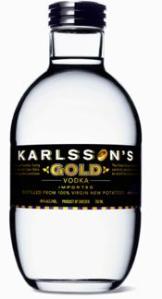
Review: Karlsson’s Gold Vodka

I’m not a big fan of vodka as far as it goes. Like many other cocktail bloggers, I think it’s something of the overhyped sibling of base spirits. Great if you want something easy and accessible for the masses, but not exactly something that has you yearning for new cocktails that explore the depths of the spirit’s flavors.

While vodka is ostensibly flavorless, there’s no doubt that vodka flavors do have a great deal of impact on what makes it enjoyable, especially if you like drinking vodka straight on the rocks with a squeeze of lime, as I do. In fact, other than a vodka soda highball on a hot day, pretty much the only way I drink vodka is by itself, adding a touch of fresh citrus. As far as it goes, I haven’t found too many peers who like drinking straight vodka. Too hardcore or something…as long as that something is on its on it tastes too much like vodka.

karlssonsThat’s a big reason why the marketing of Karlsson’s Gold Vodka – a new potato vodka from Sweden – struck me as interesting. First, in addition to receiving the bottle of Karlsson’s, I was sent a bottle of Karlsson’s branded whole black pepper in a plastic pepper mill. Why? Because on of the cocktails Karlsson’s is promoting to enjoy their vodka in is simply Karlsson’s on the rocks with cracked black pepper. In fact, the only drinks promoted in Karlsson’s material are Karlsson’s on the rocks with pepper and a dry martini with no vermouth and pickled potatoes. They compare their vodka more to armagnac or calvados – something flavorful and complex, worthy of being enjoyed on its own.

What makes Karlsson’s unique is that it is made from virgin new potatoes. But not just one kind of potato – seven varietals of golden potatoes from Cape Bjare. The result is a vodka that seeks to be flavorful, not flavorless.

Opening the bottle for the first time, it was immediately clear I wasn’t dealing with regular vodka. The odor from Karlsson’s Gold hit me immediately. The nose has a strong alcohol scent, with floral elements alongside lemon peel, raw potatoes, and caramel. It hits the tongue with a familiar vodka taste, but where you’d expect most vodkas to pass without much else, Karlsson’s lingers. I got an interesting combination of herbs and citrus flavors, with grapefruit, sage, and a little vanilla. It has a slightly oily mouth-feel, but goes down smoothly with very little burn.

I figured to keep it simple, I would taste Karlsson’s how they think their vodka should be tasted.

Black Gold

2 oz Karlsson’s Gold Vodka

3 mill turns of black pepper

Build in a rocks glass. Crack pepper over the glass.

Well there’s not too much to say about this. It’s the same vodka I just drank, chilled and with some cracked pepper. The pepper is a subtle addition to the vodka’s flavor profile. It compliments the complex flavor of Karlsson’s , but doesn’t overpower it.

The material Karlsson’s sent me included a recipe for a martini, written in prose, that reads:

“Stir Karlsson’s Gold Vodka thoroughly in a mixing glass filled with ice. Strain into a chilled martini glass and garnish with green olives or why not try it with pickled strings of potatoes. Karlsson’s Gold, on its own, has all the floral characters otherwise provided by Dry Vermouth.”

While I noted above that Karlsson’s does have floral elements in its flavor profile, to say that it has all the floral characters of dry vermouth is hyperbole of the highest order. As someone who (1) vastly prefers gin martinis to vodka martinis (if I’ve had 2 vodka martinis in my life I’d be surprised) and (2) likes my martinis about as wet as anyone in the North American continent, I don’t buy that Karlsson’s can make up a martini all on its own. That is, not unless you want a chilled glass of Karlsson’s with a savory garnish. Oh and that chilled glass of Karlsson’s with a savory garnish isn’t the Black Gold.

Nonetheless, I figured I’d give Karlsson’s the benefit of the doubt and make what is, for me, a very dry martini with a 4:1 vodka to vermouth ratio (and a garlic-stuffed olives for garnish).

Dry Vodka Martini

2 oz. Karlsson’s Gold Vodka

.5 oz. Noilly Pratt Dry Vermouth

Stir in an ice-filled mixing glass. Strain into a cocktail glass. Garnish with garlic-stuffed olives.

As I said above, I’m not a big fan of vodka martinis. This certainly has much more flavor than any I’ve ever had before, but it’s not what I think of when I think about having a martini. I like a very wet martini and this is not that. Nonetheless, I think this is probably a more accessible martini for regular vodka drinkers than a gin martini. After all, there’s generally a bit of a stigma in American casual drinking about gin martinis. Karlsson’s could show vodka drinkers that it’s ok to have flavor in a martini – flavor that comes in larger doses than whatever was added from the vermouth. I don’t think Karlsson’s should be afraid of pairing their vodka with dry vermouth – and Noilly Pratt did the job well, marrying its own herbal profile to the vodka’s.

Karlsson’s Gold strikes me as a vodka meant for people who enjoy complex base spirits. I don’t think the average Vodka and Cranberry drinker is looking for a vodka like Karlsson’s. But if someone is looking for an interesting vodka with aspirations for capturing a consumer’s imagination for what vodka meant to stand alone could taste like, then this is good for you. Which, incidentally, means that it’s good for me. I could see this working well in a Bloody Mary or even a wetter martini, but beyond that I’m not sure I’d mix Karlsson’s with much more than ice. Maybe it’s because I may be their target audience, but I have a lot of respect for the distillers of a vodka that makes me – an “I don’t love vodka” cocktailian – react this way to tasting their spirit.

Posted by: Matt Browner Hamlin | March 29, 2009

Smoked Beer

Märzens are one of my favorite beer varieties. Since they generally only come out around Oktoberfest, I usually try to go heavy on my märzen drinking every fall. I once purchased Schlenkerla’s Märzen, expecting my usual, delightfully sweet and malty Bavarian märzen and got the biggest surprise of my alcohol-consuming life. I saw “Märzen” on the label and assumed it was a normal Märzen. Boy was I wrong.  It’s not that smoked beers are off-putting per se. It’s more that it’s a flavor that’s as far as you can get as possible from a regular märzen. Once I processed that I was actually drinking a smoked beer, I enjoyed it. But that first shock…

Clay Risen of The Atlantic’s Mixmaster blog has a good write-up on Schlenerkla’s smoked beers.

Posted by: Matt Browner Hamlin | March 27, 2009

Brief Interruption

Posting on the site has been light for my tastes the last two or three weeks. For that I apologize. Or at least, while the posting has been somewhat lighter, it has been much more focused on videos and commentary on other peoples’ writing. The truth of the matter is that I’ve been fairly sick the last two weeks with what started out as the flu (I lied to myself and said it must be a cold, but I was wrong) and then became some sort of upper respiratory funk. In this time I haven’t had a sense of smell and have been on antibiotics and cold meds to make me incapable of doing any tasting or recipe development. My liquor cabinet has remained closed, with bottles gathering dust.

I’m hoping that I’ll be back in cocktail blogging shape in the next few days. While I enjoy blogging beyond simple reporting on bars, reviewing spirits, or tasting recipes, I like having those areas as a backbone to this site.

Stay tuned for more – I do have a few spirits to review, as well as updates on cherry-vanilla bitters I’m currently making. I’ve also recently acquired bitters from The Bitter Truth in Germany. I look forward to playing with their Orange Bitters and Jerry Thomas’ Own Decanter Bitters.

Posted by: Matt Browner Hamlin | March 25, 2009

Mixologist

Every time I hear the word “mixologist,” regardless of its genealogy, I tend to think of either flair bartending in an 80s movie with Tom Cruise, or being served something with vodka, sweet liquour, and sour mix. It’s a hurdle I can’t get over, regardless of long-standing the word’s history of use in respected cocktail circles. But everyone’s entitled to their own opinion…

Posted by: Matt Browner Hamlin | March 23, 2009

Signature Drinks

I think Anna Fricke’s Proof blog post on signature cocktails raises a good point: what you order in a social setting often does say a lot about you. Or rather, it is a statement about who you are. Moreover, the context in which you’re ordering makes a bigger statement. Ordering a strawberry daquiri at a dive bar says a lot more than it does when ordered at a beachfront cabana. Asking for a Martini or Manhattan at a fine steakhouse bar doesn’t say quite as much as when the same cocktails are ordered at your run of the mill Irish pub. It’s not shocking that certain drinks tend to fit into certain environments far better than others. The real test is when you’re in an all things being equal-type atmosphere – but does that place even really exist?

I can think of a number of different scenarios based on the types of bars I’d go to – but each demands a different context for figuring out what the acceptable range of orders.

  1. The Deep Dive – Normal drinks include beers, highballs, and shots/booze on the rocks.
  2. Decent Beer Bar – Same as the Deep Dive, but with a better beer selection.
  3. Nice Bar – Like the Decent Beer Bar, but you have a bartender who can make good cocktails & a meaningful wine list.
  4. Hotel Bar – A good Hotel Bar should be dissimilar from a Nice Bar, a great one could be like a Cocktail Lounge. Sadly most miss both of these marks.
  5. Cocktail Lounge – You’re here for cocktails and ordering a beer or a highball makes you look like a punk.
  6. Wine Bar – Like the name sounds, you should be coming here for wine and not much else.

That’s pretty much my normal range of bars. I’d say that the range of understandably signature cocktail orders varies with each of these bars. The question is, what do you want to say about yourself.

Personally I think you should order what you want, when you want it, as long as it will come in a drinkable form. If you’re at a bar that doesn’t have bitters and the vermouth is probably older than the average fourth grader, then maybe that Manhattan isn’t a great idea. There shouldn’t be pressure to order “the right thing” in a social context, only on ensuring that you can get something decent to drink at the bar you’re visiting.

Posted by: Matt Browner Hamlin | March 21, 2009

Duck Fart

I’m posting this because it’s a funny, funky shot tied to a place I used to live: Anchorage, Alaska. If I ever had this, it was only once, but I know it’s something that we always laughed at on menus, while trying to get friends to order. Chow.com has posted the recipe for a Duck Fart, a quirky Alaskan pousse cafe.

Duck Fart

1 ounce Kahlúa
1 ounce Baileys Irish Cream
1/2 ounce Crown Royal Whisky

Pour Kahlúa into a 3-ounce shot glass. Using the convex side of a bar spoon, slowly pour Baileys over the Kahlúa, making sure not to disturb it, to create a layered effect. Using the same technique, layer the Crown Royal over the Baileys.

Amy Wisniewski writes:

An Alaskan original created more than 20 years ago at the Peanut Farm in Anchorage, this layered cocktail is said to be named for the sound you’ll make after drinking one.

I never knew that the Duck Fart originated at the Peanut Farm, a big Anchorage sports bar I’ve been to a few times. It’s common on Alaskan bar menus in Anchorage and beyond. It’s also something you should be able to get in just about any bar in the Lower 48. Enjoy!

Posted by: Matt Browner Hamlin | March 20, 2009

Shaking vs Stirring

Jeffrey Morgenthaler demonstrates the differences between shaking and stirring cocktails, as well as when you should use which method.

Bonus points to the commenter who can tell us all why James Bond is, shall we say, wrong in his request to have his vodka martini shaken.

Posted by: Matt Browner Hamlin | March 18, 2009

Chicago

I’m in Chicago for a conference this week. I’d planned on going to The Violet Hour last night, but got very sick on Monday and most definitely was not up for a trip to a great cocktail bar last night. Maybe if I feel better tonight I’ll try to swing by The Violet Hour, which I have on good reports is a cocktail bar I’ll absolutely love. Oh and it goes without saying that I didn’t feel up for taking a trip to one of Chicago’s 16,982 Irish pubs for St. Patrick’s Day.

Posted by: Matt Browner Hamlin | March 17, 2009

Happy St. Patrick’s Day

“Top ‘o the morning to ye on this gray, drizzly afternoon. Kent ‘O Brockman live on Main Street, where today, everyone is a little bit Irish! Eh-heh, except, of course, for the gays and Italians.”

–Kent Brockman, The Simpsons

Well it’s St. Patrick’s Day. Sadly three big things are holding me back from really enjoying it: (1) I’m really sick; (2) It’s a Tuesday and I’m working; and (3) I’m about to get on a flight to Chicago for work. Oh well, can’t win them all.

Last year was a different story. I was in Europe for my first vacation in a long, long time and had decided that I might as well swing through Dublin for St. Patrick’s Day. I used to go to school in Dublin, but hadn’t been to Ireland in about 10 years. It was great to be back in Dublin and even see some old friends.

I’d heard that St. Patrick’s Day in Dublin wasn’t quite the carnival of insanity that it can be in American cities like New York or Boston. A lot of the people out and about in Temple Bar and other big bar neighborhoods in Dublin were tourists, but I got the impression that the strong majority were Irish. Like most big cities, there were some bars that were filled with more obnoxious crowds than others. It didn’t take rocket science to figure out which places were going to fit with the atmosphere we were looking for, so to whatever extent there were parts of Dublin that were overly saturated with tourists or wankers.

I was in Dublin for three days with my friend Aaron. We started the day with a giant dragon blimp in the parade crashing into our third floor hotel room. It turns out the parade route went right past our hotel (something we should have realized when we were forced to climb metal barricades to get back onto our block late the night before. We left our hotel after the parade moved past and started searching for a good pub to have a proper Irish fry for breakfast. That took a bit more walking than we expected, but was good as it put some distance between waking up and when we finally started our St. Paddy’s Day festivities.

I’m not going to go into any detail on what we ended up doing on St. Patrick’s Day – I don’t have the names of the pubs, but needless to say it was a blast. We had a decent routine of spending not much more than a beer or two at a pub, unless we met cool people. One place was rocking with sing-alongs and we ended up spending a long, long time shouting along to old U2 and Oasis tracks, intermingled with classic Irish drinking songs.

What did we drink? Well, pretty much everything. Early on it was Guinness and Smithwick’s. Later on it was Guinness, Jameson, and a cider or two mixed in for good measure. While St. Patrick’s day in Dublin wasn’t any more intense an experience that I’ve had in NYC, it had a different emphasis. In my experience, American celebrations of St. Patrick’s Day are pretty much focused on getting as drunk as possible, as early in the day as possible. While there was certainly a lot of drinking in Dublin, the emphasis was on meeting people, singing, and having fun. It was light-hearted and low-key, even with throngs of people crowding the streets of Temple Bar.

I’m disappointed that I’m not in Dublin today to celebrate. I had a blast there last year and I highly recommend trying, at some point in your life, to celebrate St. Patrick’s Day in Ireland. Until then, have some good craic and enjoy being Irish for the day!

« Newer Posts - Older Posts »

Categories