I can’t pick a winner. Maybe you can.
versus
I guess the ideal would be re-editing the bottle opener video with the music from the Red Stripe video’s audio.
I can’t pick a winner. Maybe you can.
versus
I guess the ideal would be re-editing the bottle opener video with the music from the Red Stripe video’s audio.
Posted in Beer & Cider
Derek Brown’s latest piece at The Atlantic is a really interesting history of the Suffering Bastard, a favorite of mine. I had no previous knowledge of the drinks colorful history (to go along with its colorful name). Here’s the recipe Derek uses for his Suffering Bastard:
Suffering Bastard
2 dashes Angostura bitters
Ginger beer or ginger ale
1 ounce gin
1 ounce brandy or bourbon (according to your tastes the night before)
1 teaspoon lime juice, sweetened (Fee Brothers or Rose’s sweetened lime juice)Fill highball glass with ginger beer or ginger ale. Add remaining ingredients, stir well, and decorate with slice of lemon and slice of lime and a sprig of fresh mint. Drink deeply.
Seriously folks, if you’ve never had one of these, I highly recommend it. It’s far more complex and interesting than your usual Bourbon & Ginger or Dark & Stormy. Plus it’s one of the best examples of how cocktails using two very different base cocktails can be made and still be balanced, complex, and refreshing.
The Third Annual DC Craft Bartenders Guild Rickey Month has come and gone, but DC remains hot and muggy. But as it goes, we have a New Champion who will reign over the city that birthed the Rickey: Alex Bookless of The Passenger. Her cocktail, The Root of All Rickey, came in first place in a very tough field that included Dan Searing of Room 11, Gina Chersevani of PS7s, Adam Bernbach of Proof & Estadio, and David Fritzler of Tryst.
I liked Alex’s cocktail – it was light and refreshing and was the only entry I tasted that effectively used both gin and bourbon in the recipe. That said, I think I preferred Dan Searing’s Balmy Rickey, which was simpler and really in line with the traditional Rickey. I also really enjoyed Adam Bernbach’s Salty, Limey, Ginny Thing, which was a really interesting and complex take on a traditionally simple drink. Making a more complex tasting Rickey while having it still be a Rickey is quite an achievement.
Svetlana at Brightest Young Things has the recipes for both Alex’s winning cocktail and Dan’s, which came in second. Here they are:
The Root of All Rickey by Alex Bookless
1.25 oz Hendrick’s Gin
0.5 oz Woodford Reserve Bourbon
Juice of half a lime
4-5 oz root soda (her recipe)Build over ice and serve in a red wine glass or goblet.
Balmy Rickey by Dan Searing
1.5 oz Woodford Reserve Bourbon
1/2 of a lime, quartered
8 lemon balm leaves, plus a spring
1 tsp 1:1 simple syrup
Soda waterMuddle lime with lemon balm in a highball. Add bourbon and simple syrup and stir. Add ice and stir again. Top with soda water and garnish with lemon balm sprig.
Kudos to the DC Craft Bartenders Guild for putting on another phenomenal month of original cocktails in honor of DC’s original cocktail. The Rickey is a tremendously simple cocktail and modifying it while having it still be a Rickey is a very tough task. But those who were able to do it produced some really great drinks that will hopefully stay on District cocktail menus for a long time to come.
Posted in Cocktail Culture, Contests

It’s time to party!
Of this list, I’ve only had Dan Searing’s Lemon Balm Rickey. It was phenomenal – perfectly a Rickey and still an original cocktail. What’s more, it’s a bourbon-based Rickey and in my experience these are among the hardest to modify well. Kudos Dan!
I hear Adam Bernbach and Gina Chersevani’s are also incredible, though I can’t say that is surprising.
I’ll be at The Passenger this coming Monday to see which comes out on top.
Before I got into cocktails and before I got into rye whiskey, I got into Templeton Rye. Templeton is a Prohibition era whiskey made in Iowa. I was working on a political campaign at the time and Templeton was a favorite of our Iowa field staff. It’s really a great product – one of the more interesting ryes in my view, built more for sipping than cocktails. Sadly, it’s not available any place I’ve live since then, but if you or a friend is passing through Iowa, make sure to pick up a bottle of Templeton.
I received an email from Templeton today announcing the death of Meryl Kerkhoff, their master distiller. I never met the man, but he made a rye that has literally been the definition of for me over the last number of years. Templeton has recently completed a series of videos of wherein Meryl reminisced about his time and experiences with Templeton. The first segment is posted above and the video playlist can be viewed here.
The full email from Templeton announcing Meryl’s passing is below the fold.
I’m going to be a judge tonight in Washington City Paper’s Clash of the Cocktail competition. I may be so overcome with enthusiasm for judging this contest that I decide to also take on the roles of jury and executioner, though that may be considered impolite for this sort of thing. I’d previously written about the contest here.
This will be my first foray into judging, but fortunately the panel has other very talented and knowledgable people, including Phil Greene of The Museum of the American Cocktail. I’ll post updates about the event later on, so stay tuned.
Posted in Contests
Good update – video from the Wild Turkey Blogger Tasting that I wrote up last month is now online. Check it out above.
Posted in Bourbon
Via Mike at Whisky Party, I found out the Brandy Library in New York is having a small, non-professional only cocktail creation contest featuring Elijah Craig 12 year old bourbon. The Bourbon Cocktail Challenge is taking place this week and I’ve submitted an original creation to it.
Here’s my submission to the contest:
A Lively Corpse
1 oz bourbon (Elijah Craig 12 year old)
1 oz triple sec (Luxardo Triplum)
1 oz vermouth blanc (Dolin Blanc)
1 oz fresh lemon juice
2 dashes absinthe (Kubler)Combine all ingredients and shake over ice. Double strain into a chilled cocktail glass. Garnish with a bourbon cherry.
I was actually pretty surprised and pleased to get a workable Corpse Reviver variation with a bourbon base. This comes out quite well-balanced, though still boozy and tart. The Dolin Blanc actually holds up far better than I’d expected with some robust ingredients.
While I really enjoyed making A Lively Corpse, it was actually the second drink I’d submitted to this contest. My first is a drink I call the Danube Sling.
Danube Sling
2 oz Elijah Craig 12 year old1 oz Maraska Pelinkovac0.75 oz simple syrup0.5 oz fresh lemon juice3 oz club sodaPour Elijah Craig, Pelinkovac, syrup and lemon juice into a shaker, add ice and shake. Double strain into an ice-filled highball. Top with club soda. Garnish with a thick lemon peel and a bourbon cherry.
Posted in Contests, MBH Creations
I would have noted it sooner, were I not on vacation, but we are now into July and the third annual DC Craft Bartenders Guild Rickey Month.
The Rickey is probably the most famous cocktail native to Washington DC. Here’s the story:
Invented in 1883 at Shoomaker’s by George Williamson at the bequest at Colonel Joe Rickey. The drink consists of any base spirit with lime juice and sparkling mineral water or soda. The original was with Bourbon served in a goblet with ice and the lime shell was dropped in the glass. It was not served with sugar.
Derek Brown often describes the Rickey as “air conditioning in a glass.” Living in DC for a number of years now, I can attest with great conviction the validity of Dereks’ description. There really are few things more refreshing on a hot, humid, swampy DC summer day than a Gin Rickey or my vermouth blanc variation. Plus the recipe model allows for any base spirit – so if gin or bourbon isn’t your thing, try it with something else!
Marshall at Scofflaw’s Den has a rundown of all the participating bartenders, a list that seems to grow dramatically every year:
Owen Thompson of Café Atlantico
Gina Chersevani of PS7′s
Chantal Tseng of Tabard Inn
Adam Bernbach of Proof
Dan Searing of Room 11
Clinton Terry of PX
Jayson Smith of PX
Justin Owens of PX
Rico Wisner of Poste Brasserie
David Fritzler of Tryst
Joey Ambrose of W Hotel
J.P. Caceres of Againn
Duane Sylvestre of Bourbon Steak
Laura Secker of Vermillion
Elli Benchimol of Chef Geoff’s (both locations)
Amy Troutmiller of Urbana
Joseph David Cleveland of Oyamel
Mike Cherner of Mie N Yu
Milton Hernandez of Bibiana
Rachel Sergi of 701
Jessica Crandall of Bourbon (Glover Park)
Theo Rutherford of Ripple Wine Bar
Alex Bookless of the Passenger
Julia Hurst of the Passenger
Alex Nichols of the Passenger
J.P. Fetherston of the Passenger and Columbia Room
Patrick Owens of Jaleo
Last year I didn’t get to do a good job of sampling the Rickeys being offered around town. I aim to do much better this year.
If you’re in DC, any of these bars should be able to serve the cocktail regardless of whether or not the bartender who has created it is behind the stick. Marshall has more details about how to sample Rickeys around town this month and where the final hootenanny will be:
On August 2nd beginning at 6:30pm at The Passenger in Mt. Vernon Square (1021 7th Street, NW) there will be a Rickey party sponsored by Hendrick’s Gin and Woodford Reserve Bourbon.
What? That’s not good enough? Geez, you youngins and your whatnots . . .
Okay then, go to one of the participating establishments to sample a Rickey and get you a Rickey passport. If you visit ten contestants during the month of July, and get your Rickey Passport stamped, entrance to the finals of the contest is free. Otherwise, the event will be $10 at the door and include one free classic Rickey.
Finalists will be serving their drinks to attendees at a cash bar and competing for the grand prize of $1,000 chosen by special guest judges Ana Maria Cox of GQ, Jim Hewes of the Round Robin Bar at the Willard, Tad Carducci of Tippling Bros., Peter Smith of PS7’s and Jenn Larsen of WeLoveDC.com.
There go folks…now go off and get cool in the DC heat!
Posted in Cocktail Culture, Contests, Events
I just spent a week vacationing in Puerto Rico – a couple days in San Juan and the rest in Vieques. I drank more Piña Coladas in the last eight days than I have in my entire life beforehand. Puerto Rico in July is HOT and Piña Colada is a great cocktail to cool off. Is there any other time to have a frozen cocktail than when it’s in the upper 90s?
While in San Juan, I stopped by Restaurant Barrachina and the Caribe Hilton, both of which claim to have invented the Piña Colada in 1963 and 1954, respectively. I’d been to Barrachina before and enjoyed their Piña Colada, which was made with Ron del Barrilito Two Star. The downside with it is that they serve it mixed from a frozen drink machine and then add rum to it without mixing. They do this because they regularly serve over 1,000 Piña Coladas a day and do even more during peak seasons. It’s an understandable problem, but definitely detracts from a well-made cocktail.
The Piña Colada at the Caribe Hilton was mixed from scratch, but made with white Puerto Rican rum. It lacked the flavor of an aged rum. I ordered a second one with aged rum and got a fairly wild and overly potent concoction that used three kinds of dark rum. It was basically undrinkable.
Between the two, I’d say I preferred the Piña Colada from Barrachina by a long way.
But neither of the claimed originators provided the best Piña Colada I had on the trip.
In fact, the best Piña Colada I had in Puerto Rico – sampling from about twenty bars and restaurants in San Juan and Vieques – was from the W Hotel in Vieques. It was rich, creamy, and balanced, with great consistency and a paper-thin dried pineapple cross section as a garnish. Duffy’s in Esperanza was a close second, though it was interestingly made with Cruzan aged rum. Bananas in Esperanza was also top notch, though not quite as flavorful and rich as the one available at Duffy’s, it had exquisite consistency. I definitely got a kick out of two of the best Piña Coladas in Puerto Rico that I had coming from waterfront dive bars and not the slick joints that claim to have created the cocktail. At least that was my experience.
For a complete analysis of the history and recipe of the Piña Colada, check out the work of Giuseppe and Richard of Painkiller.
Last week I participated in a live tasting and web video chat with Wild Turkey’s master distiller Jimmy Russell and associate distiller Eddie Russell. Prior to the event I’d been sent samples of Wild Turkey 101, Wild Turkey Kentucky Spirit, Russell’s Reserve 10 year old Bourbon, Wild Turkey Rare Breed, Russell’s Reserve 6 year old Rye, and Wild Turkey American Honey. The event was Jimmy and Eddie leading a group of bloggers in a tasting of each of this bottlings and sharing their stories from two lives of making whiskey.
I’d met Jimmy Russell briefly last year at a Wild Turkey tasting at Bourbon in DC. He was just as affable with a half dozen bottles of whiskey and a camera in front of him as he was in person.
One of the things that stood out in this tasting was the extent to which making bourbon is a family affair, with progress measured in the time frame of a person’s lifetime. Jimmy Russell has been making bourbon since the 1950s and his vision for Wild Turkey is the one that largely drives what the distillery does. I asked Jimmy and Eddie if they’d considered selling an unaged or white whiskey. Jimmy pointed out that in eastern Kentucky, his friends call that moonshine. While tastings of unaged whiskey are available at the distillery, Jimmy said that he doubted they would start selling moonshine while he was alive. And this was something that we heard at least three or four times over the course of the tasting – experiments or different types of bottling would not be tried while Jimmy was alive.
Anyway, on to the whiskeys.
We started with Wild Turkey 101. This is a bourbon that has always been a favorite, as I could get it at most bars (including a lot of great East Village dive bars). It’s mostly made with seven year old bourbons, but has some six and eight year mixed in as well. It starts with heavy caramel smell on the nose, but doesn’t have an alcohol scent even with the higher proof. The taste is a classic bourbon taste – caramel, honey, and vanilla stand out. There’s a big, bold finish and the taste lingers for a while. Something that you see with the 101 but is common throughout Wild Turkey’s bourbons is that the finish actually leaves the tongue slightly cool. Jimmy and Eddie say this is by design and seeks to make the whiskey refreshing.
Next we tried Wild Turkey Kentucky Spirit, a single barrel bottling. Jimmy hadn’t wanted to make the Kentucky Spirit because he wanted all the bottles of a product sold to taste the same and it’s really hard to do this with single barrel bottling, because there is a different taste between barrels. The Kentucky Spirit starts off with more alcohol on the nose than the 101, with hints of vanilla and fruit. I start off with a toffee taste and richness of oak. There’s also a rye flavor on the tip of the tongue that has a peppery pop to it. It’s actually more mild than the 101 and has an oily mouth feel. There are also really long, thick legs on the glass.
Russell’s Reserve 10 year old Bourbon was one of my favorites of the evening. Apparently Jimmy was reluctant to have a product line with his name on it. But once they moved forward, he wanted a well aged bourbon. The Russell’s Reserve starts as a 101 proof, but is lowered to 90 proof with water. It has very thin legs and a very strong alcohol and caramel bouquet on the nose. Up front, the Russell’s Reserve bourbon has a light taste of honey and nuts, but a really strong finish. The finish is a big, thick vanilla flavor; I also tasted rootbeer coming through. There’s a burn on the back and sides of the tongue. This was a good example of how everyone’s palate is different and will taste different flavors in a whiskey.
We next tasted Wild Turkey Rare Breed, a twelve year old bourbon. It is barrel proof – bottled straight from the barrel – at 108.2 proof and only made in small batches of barrels. It has a really big nose and great woody profile. It had what I found to be the richest, oiliest mouth feel and an intense caramel color. The bourbon starts with lots of spice and a rich caramel sweetness up front. It has an incredibly long finish, with notes of dark chocolate. It really doesn’t taste as hot as you would expect a 108 proof bourbon would taste.
We next moved to taste the Russell’s Reserve six year old Rye. It had pretty thick legs and a nose of honey and lemon. While there’s a good deal of flavor in the rye, it is much more earthy than bourbon. The flavor is salty, earthen, and a little bitter up front, with a slightly sour finish.
Jimmy and Eddie both credited modern craft bartenders and the younger generation with bringing rye back to prominence in American drinking. Eddie said, “Not many people drink rye, then all of a sudden, the younger generation is using rye. [Modern mixology] is the biggest thing that is driving rye production in the industry.” When they first made Russell’s Reserve Rye, they sold out within the first few months. Right now, Jimmy and Eddie predicted that they will need three to four years before they can supply enough rye for what people need. The size of the phenomenon seems to have caught them by surprise and this isn’t the sort of product that you can magically create when there is month to month or year to year demand.
The tasting finished with Wild Turkey American Honey, a bourbon-based liqueur. I’m pretty familiar with it, as a number of women I’m friends with swear by it. It’s really a dessert product that Jimmy and Eddie recommended be poured on top of ice cream or added to lemonade. American Honey has a very thick and creamy mouth feel – a lot like honey. The flavors are fairly straightforward – bourbon, honey, and a light bit of lemon. It’s a great product for people who don’t like bourbon, but a bad one for people who don’t like honey.
A couple other notes from the tasting…
While the event was really fun and interesting, the quality of the production was unfortunately not up to snuff. The audio quality was pretty horrible on both the live stream and the conference call audio line. I’ve done a lot of events like this in my professional life and there are lots of things that can go wrong, but doing things right is also manageable with experience. Hopefully if they do another event like this, there will be better a/v setup. Of course, the quality of the live stream didn’t diminish the quality of the bourbon. The event on whole was great and I’m appreciative of the folks at Wild Turkey for pulling it together.
Disclosure: This post was made possible because I received free samples of Wild Turkey 101, Wild Turkey Kentucky Spirit, Russell’s Reserve 10 year old Bourbon, Wild Turkey Rare Breed, Russell’s Reserve 6 year old Rye, and Wild Turkey American Honey.
Gary Regan, in his column in the San Francisco Chronicle earlier this month, posted a new recipe for a cocktail made with rye, bourbon, and Xante pear liqueur. I’ve been pretty enamored with Xante since I first tried it, but haven’t seen it used successfully in too many cocktails yet. I’ll have to give this one a try soon:
Between the Damms
1 1/2 ounces 10-year-old Michter’s rye
1 1/2 ounces Elijah Craig 18-year-old single-barrel or other well-aged bourbon
1 1/2 ounces Xanté pear liqueur
1/2 ounce fresh lemon juice
2 dashes Angostura bittersInstructions: Place all ingredients in a cocktail shaker. Add ice. Shake and strain into a chilled cocktail glass.
One of the first non-highball cocktails that I got into making for myself was a gin Gimlet. I was in college and to that point, a cocktail was a Jack and Coke, a Gin and Tonic, or, if things were adventurous, a Margarita from a mix. For some reason, though, a Gimlet seemed like a good change of pace on a hot summer day. Honestly, my Gimlet phase didn’t last more than a few months, in part because I never found a balance that worked with Rose’s Lime Juice that I really liked.
We all know Rose’s. It’s cloyingly sweet, chemically tart, and a disturbing yellow-green color. And if you’ve ever had a cocktail with a heavy pour of Rose’s, you’ve probably regretted your choice and wondered why someone would make such a product in lieu of fresh lime juice. Lime cordials were created to help prevent scurvy amongst sailors during the 1800s. According to The Museum of the American Cocktail’s pocket recipe book, “the Gimlet was created by a clever ship’s surgeon, Sir Thomas D. Gimlette, sometime during the late 1870s.”
If you’re going to be a stickler, Rose’s lime juice is required for a Gimlet. A side effect of this is it is a cocktail that I have essentially never had since I got into craft cocktails. I haven’t wanted to waste my time on a cocktail made with Rose’s. This is really a shame because a well made Gimlet can be incredibly refreshing.
Employees Only is one of the premier craft cocktail bars in New York City and their head bar chefs Dushan Zaric and Jason Kosmas have recently launched a line of artisanal syrups, including a Lime Cordial and Grenadine. They describe their Lime Cordial, which is going to be an immediate alternative to Rose’s for anyone who cares about the quality of the products they use, as ” made from 100% lime juice, sweetened with agave nectar, accented with kafir lime leaf. It’s delicate hue and true lime flavor make EO’s Lime Cordial a true artisanal product and a wonderful complement to classically inspired cocktails.”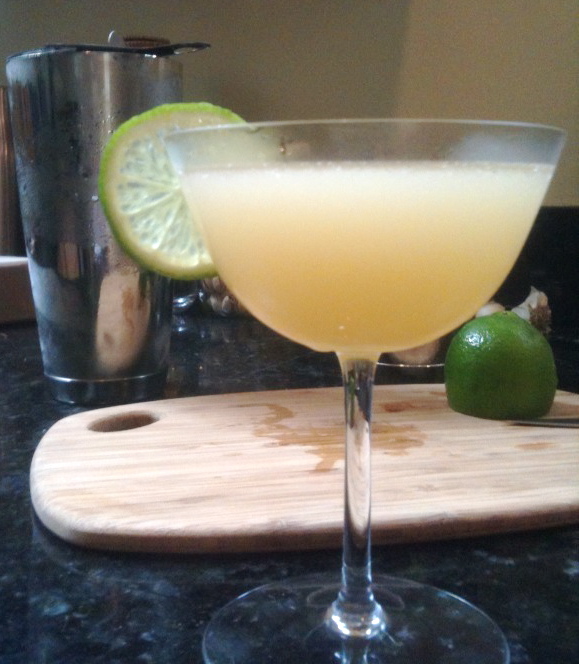
Gimlet
2.25 oz gin (Beefeater)
0.75 lime cordial (Employees Only Lime Cordial)
Squeeze of 1 lime wedgeShake ingredients over ice. Strain into a chilled cocktail glass. Garnish with a lime wheel.
I like my Gimlet’s with a tiny bit of fresh lime juice to add a bit of fresh sour flavor. But it’s still a cocktail driven by the cordial. The Gimlet made with Employees Only Lime Cordial is pretty fantastic. It is sweet, but not cloying. It’s also tart, but with the sort of lime sour flavor that you get with fresh, quality ingredients. There’s no chemical bite to it and it’s quite a change of pace from Rose’s. The use of agave as a sweetener in the cordial really lightens the sugar of the cordial and lets the lime and kaffir lime leaf step forward.
It’s also worth noting that the Gimlet with the EO Lime Cordial looks like a cocktail made with lime juice. The Gimlet takes a light golden and cloudy hue, evidence that no blue dyes were used in the making of this drink.
I’m definitely impressed with the Employees Only Lime Cordial. Lime Cordial isn’t an ingredient that I’ve used a lot of in my cocktails, but I haven’t had an ingredient that I liked the taste of enough to use. The Employees Only syrups are currently only available in New York, though they are being sold by Fresh Direct, which has got to be pretty convenient for New York cocktailians.
Disclosure: This post was made possible because I received free samples of Employees Only Lime Cordial and Grenadine.
Posted in Bitters, Fruit, & Syrups, Gin
The Washington City Paper is conducting their 2010 “The Clash of the Cocktail” event, featuring Don Julio tequila and Ketel One vodka recipes made by almost 20 of DC’s prime bartenders. You can see all the recipes and vote for your favorite here.
Last night I tried Sean Quinlan of Bar Rouge’s tequila cocktail, Too Much Chocolate and Tequila Makes Me Want A Siesta. It’s basically a heavily-bittered tequila Old Fashioned. Here’s the recipe:
Too Much Chocolate and Tequila Makes Me Want A Siesta
1.5 oz. Don Julio Reposado
1 oz. Agave Nectar
10 Dashes Xocolatl Mole Bitters (Bitter Truth)
I built this cocktail in a mixing glass, filled it with ice, stirred the heck out of it, then strained it into an Old Fashioned glass with one giant ice cube.
I tried this cocktail out of all the delicious submissions for a number of reasons. First, I love Old Fashioneds and this is an Old Fashioned to a T, as it has been known since 1806. It’s just a spirit, bitters, sugar and water (from the stirred ice). Second, there seems to recently have been a lot more cocktails made with inordinate amount of what are traditionally thought of non-potable bitters. While one ounce of Angostura Bitters in the Trinidad Sour still puts Quinlan’s drink to shame, 10 dashes is a lot of bitters…and a lot of bitters are fun.
The Too Much Chocolate and Tequila Makes Me Want A Siesta has a very rich, earthy taste driven by the chocolate bitters and agave nectar. It even has a very creamy mouth feel and taste, again driven by the agave. It’s clear that agave and these chocolate bitters really blend together well.
But how does it work as a cocktail? The heavy sweetness makes this drink accessible for people who may not like drinking tequila cocktails, but it isn’t very remarkable. The tequila flavor is easy to get at, but you have to sort through a lot of sugar to find the savory tones.
It’s too sweet for my taste and not bitter enough in the right ways. This is a drink that looks like an Old Fashioned, but with dramatically more sugar and bitters. What it isn’t is a real bitters-driven cocktail, thanks to the heavy hand with the nectar. It could have been a tequila Old Fashioned or a bitter-based cocktail, but it tried to straddle both and failed.
I wonder if the cocktail might better from having more than one kind of bitters. The bitter component becomes fairly one-dimensional with all the agave and might have been expanded if there were a second kind of bitters, say Fee Brothers Aztec Bitters or even good, old Angostura Bitters.
There are a lot of good ideas floating in Quinlan’s simple, three-ingredient cocktail, but in the end, I doubt this is something that will win out in the Clash of the Cocktail.
Update (7/27/10):
Last night I was one of three judges for the finals of Clash of the Cocktail. Sean Quinlan’s cocktail was one of four finalists that was reviewed. The version Sean made for us included Bar Rouge’s house agave nectar, which starts with a commercial brand then has over 20 spices added to it. The result was a cocktail that was not as cloying as the one I’d made with Partida’s agave nectar – and thus a far superior cocktail to the one I’d made at home and reviewed in this post. I was glad to have Sean’s version as he intended it to be made. The drink ended up coming in fourth, but was a strong competitor in a strong field of finalists.
Food related, but relevant for visiting bars with charcuterie.
Head cheese is not cheese, but it is in fact made of head.
True.
Posted in Food
Bacardi has been doing a high-quality series of videos called True Originals. Each looks at a fictionalized cocktailian bartender making their unique take on classic rum drinks. The one above highlights the Mojito, while previous versions have featured the Daiquiri and the Pina Colada.
With the video series, they are now inviting people to submit new twists on the Mojito. This is a really interesting challenge. The Mojito is a cocktail that I consider part of the canon. It does what it does incredibly well – a sublime combination of rum, lime, sugar and mint. There isn’t an easy way to modify this recipe without fundamentally walking away from what it does so well. Adding flavors while maintaining the simplicity is a contradiction in terms.
To help me think about what I wanted to make to modify the Mojito, I looked at the recipes three of my favorite bartenders use for their version. Phil Ward’s includes a heavier pour of rum and uses lime juice instead of muddling, while he adds Angostura Bitters and eschews club soda. Gary Regan has a recipe that I think of as most traditional – muddled lime, sugar, mint, rum, and club soda. And after doing some testing, I would say that Dale DeGroff has my favorite recipe for my home use:
Dale DeGroff’s Mojito
2 sprigs mint
1 oz simple syrup
0.75 oz lime juice
1.5 oz rum
2 dashes Angostura Bitters
Soda WaterMuddle one sprig of mint with lime and syrup. Add rum, bitters and ice and shake. Strain into an ice-filled high ball and top with soda water. (NB: The recipe is DeGroff’s but I don’t have his building instructions handy, so I am cribbing)
This is just a fantastic Mojito. It is light, crisp, tart, and balanced. I don’t know that I’ve ever made a better Mojito than when I’ve used DeGroff’s recipe. It’s just stellar.
When I was thinking about how I would make a modified Mojito, I wanted to reach towards DeGroff’s model, which meant using Angostura bitters and fresh lime juice. I also have found that using sparkling mineral water, as opposed to seltzer or regular club soda, yields a much crisper drink (I like using Apollinaris).
I also thought about one of my other favorite rum drinks, the Papa Doble, which is a Daiquiri with maraschino and grapefruit juice. I thought the model for the recipe, with the added fruit juice and small amount of liqueur, offered some potential structure for modifying the Mojito. I also thought the combination of mint and ginger in the Gin-Gin Mule offered a good instruction for another flavor to add to the mix.
I’m not certain that what I resulted with is what you would expect from the off-spring of the Mojito, Gin-Gin Mule and Papa Doble. Grapefruit juice was too dominant and I didn’t want to make a Papa Doble with club soda. But I do think it is something that is fun, light and clearly a relative of the Mojito, and if you look closely, these other phenomenal cocktails.
Finca Vigía Mojito
2 oz Bacardi Superior Rum
0.75 mint syrup*
0.75 fresh lime juice
0.5 oz fresh orange juice
0.25 oz Domaine de Canton ginger liqueur
Dash Angostura Bitters
Sparkling Mineral Water
MintCombine Bacardi Superior Rum, mint syrup, lime, orange, Domaine de Canton, and Angostura Bitters in an ice-filled shaker. Shake and double-strain into a crushed-ice filled double rocks glass. Top with a splash of sparkling mineral water. Garnish with a sprig of fresh mint.
* Mint Syrup: Make simple syrup with equal parts sugar and water. Add fresh mint leaves (10-12 per 4 ounces of syrup), lightly muddle mint, and let stand in refrigerator for 24 hours or until syrup has strong mint flavor. Strain mint leaves from syrup and store refrigerate the syrup until needed.
I have a couple thoughts on this creation. I think I meet the first goal I set for myself of capturing some of the flavor and complexity of the DeGroff Mojito, despite adding two new ingredients. This is definitely a different drink than the Mojito, though it stays light and refreshing. At the end of the day, I think this is a cocktail that I could enjoy on a hot, humid day in San Juan or Havana. And isn’t that the real measuring stick for the success of a cocktail inspired by a Mojito?
I went towards using a mint syrup because I wanted to find a place to have some difference from a Mojito. I think this still allows for much of the light and refreshing taste of mint. Sure, between this and the fresh lime juice, the iconic act of muddling is no longer a part of the cocktail. But I’m not going to succeed at reinventing the Mojito. It is already done too well. Simple improvements are nigh impossible. What I’ve made is a drink that is inspired by a Mojito, that seeks to honor the Mojito, but I hope is humble enough not to claim to be a Mojito.
Oh and the name, Finca Vigía, is the name of Ernest Hemingway’s house in Cuba. Again, as the Papa Doble was part of my model here, I wanted to honor him in the name of the drink.
Posted in Contests, Domaine de Canton, MBH Creations, Rum
Charbay is one of the most interesting micro-distilleries I’ve encountered. Charbay is a family affair from California that do a wide range of spirits and wines. A few months ago I was fortunate enough to try some of their 2nd release whiskey, courtesy of of Joe Riley. It is a whiskey that has its basis in beer, distilled and flavored with hops that stands out with a remarkably unique character, unlike any other American whiskey. It was a pretty remarkable spirit, though the bottle price reached upwards of $300 here in DC.
I was fortunate enough to, almost simultaneously, receive an email from Susan Karakasevic, one of the owners of Charbay. I told her about enjoying the whiskey and she offered me up a sample of the newest product from America’s newest master distiller, her son Marko. The new whiskey, Doubled & Twisted Light Whiskey, is actually Marko’s thesis project:
To become a Master Distiller, Marko was to source, distill and bring to market a spirit equal to or better than spirits he’d distilled under his Master. Marko’s thesis is a whiskey called Doubled & Twisted, which is an old distilling term referring to a critical point in the second distillation. When he told his father he had sold his first case, Miles, beamed with pride, shook his hand and said: “Congratulations, Marko. You are now a Master Distiller. Let’s drink some whiskey and smoke cigars.”
Doubled & Twisted is an unaged whiskey – white dog is really becoming popular these days, no? It weighs in at 99 proof. While Marko is still working on a barrel aged version of this whiskey, the initial product is clearly ready to go. Like his previous whiskeys, Doubled & Twisted is based around beer and hops:
Whiskey is distilled from beer, globally. If the final result is a 20 to 1 reduction, doesn’t it make sense to use the best beer possible? That’s what I did and I am sure the IPA beer I used, hops and all is the most expensive beer ever used to make whiskey. The result of using a great IPA is all the hop flavors and two row malty flavors distilled over into the final spirit. The hops give the D&T a fruity, floral, very green spicy character, unlike any other whiskey out there. That is exciting to me. I did not want to duplicate anybody’s style of Whiskey; I wanted to make my own style that accents the ingredients.
Doubled & Twisted is totally clear. In the glass it has very fine, thin legs. The nose is dominated by cherry and apple, with light hints of honey and grapefruit and floral elements that I wasn’t able to clearly pull apart.
The whiskey tastes very green and spicy up front, with a strong hops taste that comes as an amalgamation of pepper, clove and curry. The cherry that I smelled in the nose hits in the mid-palate. There is a light burn in the back of the mouth that fades quickly. While there’s a lot of flavor going on with this whiskey, it isn’t entirely balanced throughout the mouth, with much of the taste hitting the front of the tongue and fading towards the back of the mouth.
Adding a bit of ice really mellows out the spice and heat, but still there is a grassy, green, hoppy taste. The water brings out more subtle flavors of cherry and a little bit of banana. With the ice and water, Doubled & Twisted actually seems closer to a white rhum agricole than any aged whiskey I know.
Though I was really unsure what direction to take this whiskey in with a cocktail – I’ve never mixed with an unaged whiskey before – I thought the strong cherry flavors I get would pair well with maraschino liqueur. As such, I thought it might be fun (and a little crazy) to try the Doubled & Twisted in a Fancy-Free Cocktail.
Doubled & Twisted Fancy-Free
1.5 oz Doubled & Twisted Light Whiskey
0.5 oz maraschino liqueur
Dash of Angostura bitters
Dash of Orange bittersStir over ice and strain into a chilled cocktail glass
This turned out to be a great decision. The Fancy-Free with Doubled & Twisted is much fruitier and lighter than its bourbon-based relative. The unaged whiskey pairs really well with the maraschino. There’s still a good deal of heat, showing that while the flavors are compatible, the Doubled & Twisted’s unique character is not lost in the cocktail.
So with all that in mind, what can I say about Doubled & Twisted. It’s different and unique. The use of hops really takes whiskey in an exciting direction and a clear sign of Marko Karakasevic’s creativity as a Master Distiller. I don’t have a lot of experience drinking unaged whiskey (I think the last time I did, it was real West Virginia peach moonshine), so it’s hard for me to measure this against anything other than more traditional base spirits. It is definitely different and as I saw with the Fancy Free, could open up to a lot of potential cocktail pairings. And with a bottle price of $58 (but if you’re in California only) it actually is something that you can stomach the chances of mixing without going into palpitations like you might with their aged whiskey. If you like unaged whiskey and can get your hands on some Doubled & Twisted, I’m sure there are great things to be done with it in cocktails. If not, you’ll have to look longingly to the West.
Disclosure: This post was made possible because I received a free sample of Doubled & Twisted Light Whiskey.
Posted in Reviews, Unaged Whiskey


 A Jigger of Blog